What does balanced mean in practice?
Balance does not mean that every component has an equal share. It means that the parts make sense together for the result you want. A prominent flavour can be intentional; a supporting note can be useful without announcing itself at the first sip.
Start by writing one sentence about your aim. For example, 'I want the fruit impression to lead, with a quieter spice note.' Treat that as a direction to discuss: your instructor will introduce the available options and help you find combinations that suit your taste. Choosing a direction first makes it easier to decide whether each change is helping.
How do you choose a starting direction?
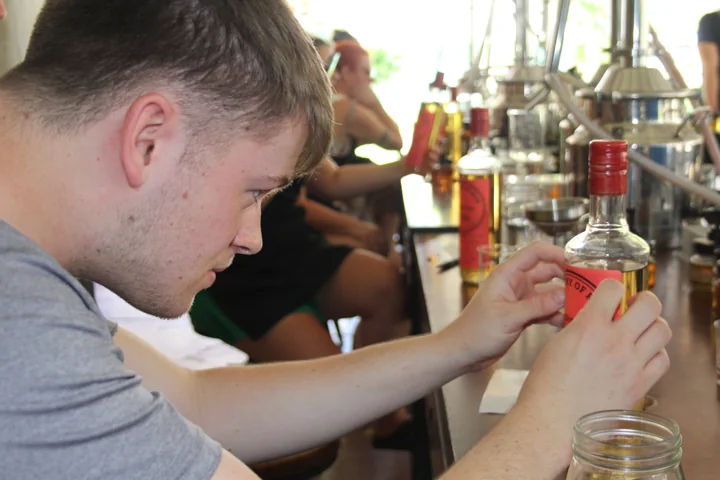
Use the tasting to notice what you enjoy and what you would prefer in a smaller role. Describe the difference in plain language. If a sample has an aroma you like but a finish you find too intense, that is useful information to discuss rather than a reason to dismiss your own observation.
Our tasting guide gives you prompts for aroma, taste and finish. Keep personal preference separate from a claim about quality: you are choosing a direction for your creation, not declaring a universal winner.
Why are small, recorded trials useful?
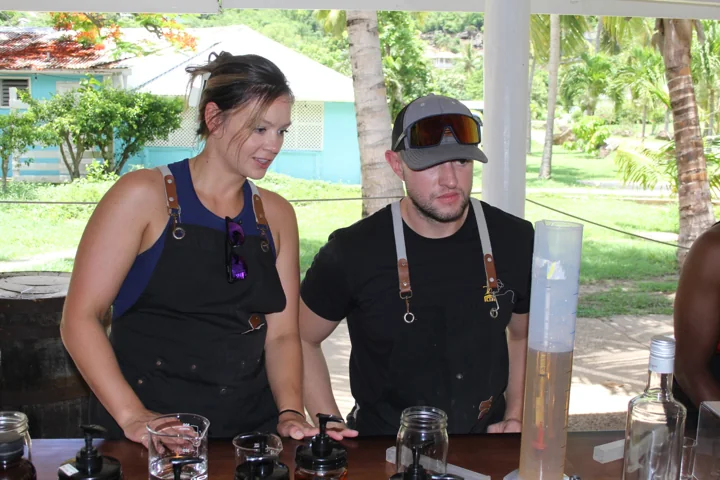
A recorded trial lets you connect a decision to its effect. Follow the instructor's measurements and process, note what you changed and compare before changing another part. If several things change together, it becomes harder to understand which one made the difference.
| Trial note | Question to answer |
|---|---|
| Direction | What do I want the main impression to be? |
| Change | What single adjustment did I make under guidance? |
| Observation | What became more or less noticeable? |
| Decision | Does that move the result towards my aim? |
Use the table alongside your instructor's measurements. Keep a note of the version you prefer before moving to the next step. If you are unsure how to adjust a trial, explain what you want to change—more aroma, a softer finish or less of one flavour—and ask for guidance. A clear observation is more useful than adding ingredients at random.
A worked example: keep the aroma, soften a competing note
Imagine your aim is a fruit-led impression with a quieter spice note. This is an example of a flavour direction, rather than a fixed recipe: your instructor will explain the actual ingredients available and what is suitable for you.
In your first trial, suppose you enjoy the aroma but find that a spice impression dominates the finish. “I like the first smell, but want less spice at the end” identifies the part you would like to change. It gives your instructor a clearer starting point than “I do not like this one.”
| Stage | What you notice | What you do next |
|---|---|---|
| Choose a direction | You want fruit to lead and spice to support it | Describe that aim before mixing |
| Compare the first trial | The aroma fits your aim, but spice dominates the finish | Ask for one guided adjustment |
| Compare the next trial | The finish feels closer to what you wanted | Record the version you prefer |
| Finish your creation | You can explain why you chose this balance | Follow the guided strength-testing and bottling steps |
The second trial does not have to be stronger or contain more ingredients. The useful change is the one that moves the result towards your aim. When sharing a bottle, ask each person to describe the same trial before deciding together. Small comparisons and clear notes are enough; there is no need to finish each sample.
How do you avoid chasing intensity?
Pause when you can no longer explain why you are adding something. More flavour, more ingredients or a higher alcohol percentage is not automatically a more satisfying blend. Return to your original aim and ask whether the latest change supports it.
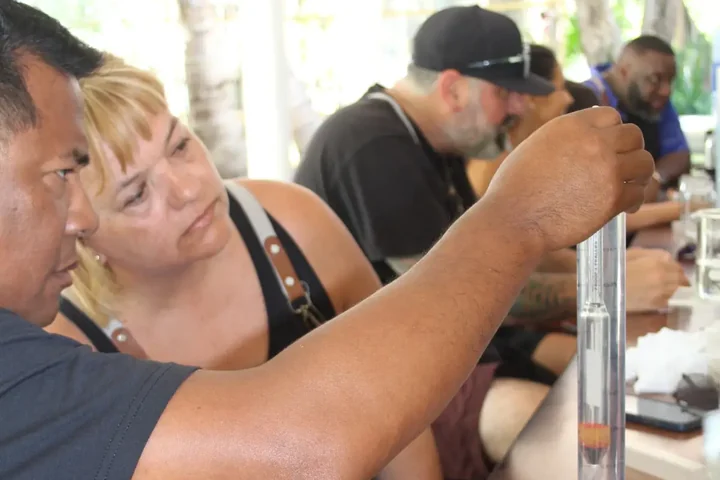
Taste only small amounts if you choose to drink, take breaks and do not feel obliged to finish samples. The Academy provides water and encourages responsible participation. Its alcohol-percentage and proof testing is guided by the instructor; it is part of learning to finish the creation appropriately, rather than a contest for strength.
Published by Academy of Rum Antigua, an interactive rum education and blending experience at Galleon Beach. External references are linked beside the information they support. For current bookings and operational details, use the experience, pricing and visit information pages.
Galleon Beach · Antigua
Experience rum differently.
Taste, learn and create your own rum at our Antigua mini distillery, with guidance from your first flavour choice to your finished bottle.
18+ to drink. Please enjoy responsibly.